Julian Calendar 2026
The Julian Calendar: What You NEED to Know for 2026
Forget the Gregorian calendar for a sec. You know, the one most of the world uses? Yeah, that one. But there’s another calendar out there, chugging along with its own rhythm: the Julian calendar. It’s got history, it’s got its quirks, and for some folks, it’s still the gold standard. So, what’s the deal with the Julian calendar in 2026? Let’s dive in.
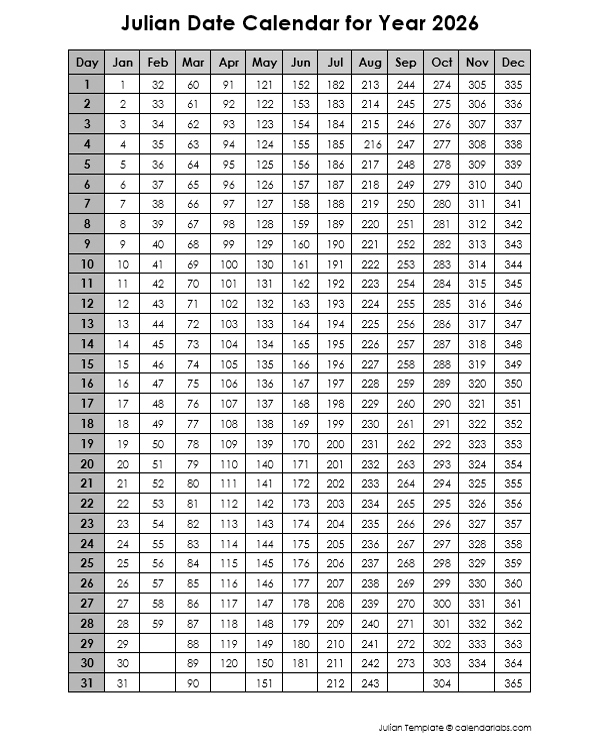
Source : calendarlabs.com
It’s easy to get lost in the shuffle of dates and times, right? Especially when technology bombards us with digital calendars every nanosecond. But understanding different calendar systems, like the Julian one, gives you a bigger picture. It’s like knowing there are different types of coffee beans – they all make coffee, but they taste completely different. The Julian calendar has been around the block, and frankly, it’s a bit of a legend.
A Blast From the Past: The Julian Calendar’s Roots
So, who came up with this thing? Turns out, it wasn’t some tech bro in Silicon Valley. This calendar’s namesake is none other than Julius Caesar himself. Back in 45 BCE, he rolled this bad boy out. It was a massive upgrade from the wacky Roman calendar that preceded it – which, by the way, was a total mess. Think random months and political interference messing with the seasons. Yikes.
The core idea behind the Julian calendar was pretty straightforward: a solar year of 365 days, with an extra day thrown in every four years. This leap year system was a game-changer, designed to keep the calendar aligned with the Earth’s trip around the sun. For centuries, it was the go-to system for keeping track of time in the Western world. It’s the grandfather of the calendar we use today, though it’s had a few… modifications.
The Julian vs. Gregorian: Why the Fuss?
Okay, so if the Julian calendar was so great, why aren’t we all using it? Simple: it wasn’t perfectly perfect. The Julian year is slightly longer than the actual solar year – by about 11 minutes. Not a big deal day-to-day, right? But over hundreds of years, those 11 minutes per year add up. Like, a lot. By the 1500s, this tiny discrepancy had pushed the calendar about ten days out of sync with the seasons. Big oof.
Enter Pope Gregory XIII. He was tired of the date drift. In 1582, he introduced the Gregorian calendar, which is basically the Julian calendar with a math tweak. It skipped ten days to realign things and introduced a more refined leap year rule (no leap year on century years unless they’re divisible by 400). This new system kept closer to the solar year. Most of Europe eventually hopped on board, but some places, like certain Orthodox churches, stuck with the Julian. And that’s why we still talk about it today.
Why You Might Still See the Julian Calendar in 2026
You might be asking, “Who cares about an 11-minute difference now?” Well, for most secular purposes, you’re right. The Gregorian calendar is the standard. But religion plays a huge role here. Many Orthodox Christian churches, including the Russian Orthodox Church and the Patriarchate of Constantinople, still follow the Julian calendar for calculating feast days and holidays. That means their Christmas is on January 7th and Easter can be on a different date than Western Easter. It’s a deep-rooted tradition.
So, when you hear about the Julian calendar 2026, it’s often in reference to these religious observances. It’s not just some dusty historical artifact; it’s a living calendar that dictates important dates for millions of people. Think of it as a cultural marker, a way of preserving a distinct religious and historical identity. Pretty cool, huh?
Key Dates on the Julian Calendar for 2026
Alright, let’s get down to brass tacks. If you’re observing holidays based on the Julian calendar, you’ll want to keep these dates in mind for 2026. It’s always good to have a visual reference, so checking out a Julian calendar view is smart. These dates are when major feasts fall according to the Julian reckoning:
Christmas Day (Julian)
This one’s a biggie. For those following the Julian calendar, Christmas Day lands on January 7th. That’s January 7, 2026, if you’re marking your calendar. It’s a significant date, celebrated with religious services and festivities, just a different day than many are used to.
Theophany (Julian)
This commemorates the baptism of Jesus. On the Julian calendar, Theophany is observed on January 19th. So, mark down January 19, 2026. It’s another important religious holiday in the Orthodox tradition.
Annunciation (Julian)
A major feast celebrating the announcement of the Incarnation. This falls on April 7th according to the Julian calendar. So, you’re looking at April 7, 2026. A day of great spiritual significance.
Feast of Saints Peter and Paul (Julian)
These two apostles are highly revered. Their feast day on the Julian calendar is July 12th. That makes it July 12, 2026. A key date for many Orthodox Christians.
Nativity of the Theotokos (Julian)
Celebrating the birth of the Virgin Mary. Mark your calendars for September 21st, which is September 21, 2026, on the Julian system. Another cornerstone feast.
Having these dates handy helps avoid confusion, especially if you have friends or family who follow the Julian calendar. It’s all about respecting different traditions and understanding the nuances of timekeeping. And hey, if you need to see it all laid out, you can always grab a quick look at a yearly Julian calendar. For example, view the 2026 Julian calendar. It’s a lifesaver.
The Julian Vs. Gregorian Calendar In 2026

Source : typecalendar.com
Why The Julian Calendar Still Sticks Around
Look, most of us are used to the Gregorian calendar. It’s what your iPhone uses, what the news talks about. But here’s the kicker: not everyone ditched the old Julian system. It’s not just some dusty relic; it’s actively used by certain groups, and figuring out Julian calendar 2026 means understanding this divide. It boils down to a slight difference in how they calculate leap years. The Gregorian, the one we use today, is smarter about it. It skips a leap year every 100 years unless that year is divisible by 400. Simple, right? Well, almost. This tiny correction, implemented way back in 1582, is why we’re even having this chat. The Julian calendar just adds a leap day every four years, period. That small difference adds up, creating the drift we’re talking about.
Leap Year Shenanigans: Julian vs. Gregorian
So, what’s the big deal with leap years? It’s all about keeping our clocks in sync with the Earth’s orbit around the sun. The Earth takes about 365.2422 days to orbit. The Julian calendar rounds this up to 365.25 days, adding a leap day every four years. Easy peasy. But that tiny fraction overestimates by about 11 minutes per year. Over centuries, that adds up to days! The Gregorian calendar got wise and said, “Hold up.” It introduced the rule that years divisible by 100 aren’t leap years unless they’re also divisible by 400. This keeps things way more accurate. For 2026, the jump between the two calendars is noticeable.
The 13-Day Gap: What It Means For 2026
By 2026, the Julian calendar is about 13 days behind the Gregorian. This isn’t some theoretical math problem; it has real-world consequences, especially for holidays. If you’re following the Julian system, Christmas falls on January 7th of the Gregorian calendar. That’s a whole week and a half later! It’s a constant reminder of the historical shift and why many Orthodox churches, for example, celebrate their major feasts on different “calendar days” than the rest of the world. This calendar difference is key to understanding any discussion about the Julian calendar in 2026.
Historical Dates On The Julian Calendar In 2026

Source : store.ancientfaith.com
When History Gets Confusing
Trying to pin down historical events when calendars are constantly shifting? It’s a nightmare. Think about it: if a diary from 1750 mentions “the 10th of March,” are they talking about the Julian calendar or the Gregorian? Depending on where and when it was written, it could be either! This is why historians get so worked up about dates. For any significant historical happenings, especially those involving places that adopted the Gregorian calendar at different times, you have to be specific. Was it 10th March Old Style (Julian) or 10th March New Style (Gregorian)? Knowing this is crucial for understanding historical events accurately.
A Hypothetical 2026 Anniversary
Let’s imagine a fictional historical event: “The Great Town Square Debate” happened on June 15th, 1776. If we’re talking about the Julian calendar 2026, when would we commemorate that? Well, June 15th, 1776, Julian, is actually July 2nd, 1776, Gregorian. So, if you were a stickler for the original Julian date, you’d celebrate your anniversary on July 2nd, 2026. It’s a bit like looking at an old photograph and realizing the people in it are wearing fashions that seem alien to you now. The date is the same, but the context, the underlying system, has changed. You’ve got to be careful not to mix them up.
Why It Matters For Modern Records
Even today, some legal documents or historical archives might reference dates using the Old Style (Julian) calendar, especially if they originate from regions that were slow to adopt the Gregorian reform. For anyone researching genealogy, property records, or even just local history in certain areas, understanding the Julian calendar’s influence in 2026 means knowing how to interpret these older dates. A birth certificate from 1850 might list a date that, when converted, falls on a different day of the week or month than you’d initially expect. It’s a historical detective game, really. You’re hunting for the old style dates.
Converting Julian To Gregorian Dates In 2026
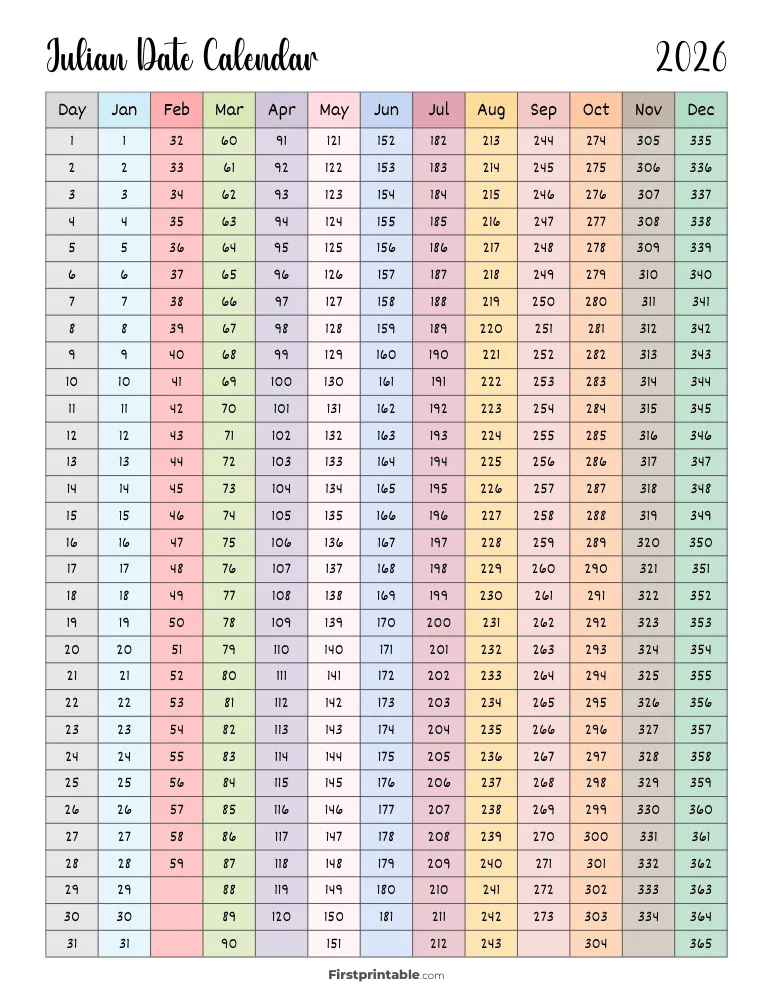
Source : firstprintable.com
The Math Isn’t Scary, Promise
Okay, so you’ve got a date from the Julian calendar and need to know what it is on our familiar Gregorian system for 2026. Don’t panic. It’s not rocket science. The difference between the two calendars grows over time. As we mentioned, right now, it’s 13 days. So, if you see a date like “January 1st, 2026 (Julian),” you simply add 13 days to it. That means January 1st (Julian) is actually January 14th (Gregorian). It’s a straightforward addition. Easy, right? This is the core of date conversion.
A Simple Conversion Table
To make things crystal clear, let’s look at a table. This shows you exactly how Julian dates translate to Gregorian dates around the Julian calendar 2026 period. It’s not just about holidays; it affects any recorded event. Remember, the gap widens over time, so the number of days you add isn’t constant throughout history. But for our purposes now, in the 21st century, that 13-day gap is what you need to know.
| Julian Date (Old Style) | Gregorian Date (New Style) | Difference |
|---|---|---|
| January 1, 2026 | January 14, 2026 | 13 days |
| January 7, 2026 | January 20, 2026 | 13 days |
| February 1, 2026 | February 14, 2026 | 13 days |
| March 1, 2026 | March 14, 2026 | 13 days |
| April 1, 2026 | April 14, 2026 | 13 days |
Why This Conversion Is Still Relevant
You might be thinking, “Why bother with all this Julian to Gregorian conversion stuff in 2026?” Well, like I said, millions still follow the Julian calendar for religious observances. And some historical documents? They’re still out there, using the old system. So, if you’re trying to understand when the Orthodox Christmas is, or if you stumble upon an old family record, knowing how to bridge that gap is incredibly useful. It’s about accuracy and respecting the different ways time has been measured. It’s not just historical trivia; it’s practical for many.
Orthodoxy’s Holidays On The Julian Calendar In 2026

Source : store.ancientfaith.com
Christmas: January 7th, Not December 25th
This is the big one, folks. For a massive chunk of Orthodox Christians, Christmas isn’t on December 25th. Nope. Because they use the Julian calendar, Christmas Day falls on what we in the West know as January 7th. So, when you hear about Orthodox Christmas celebrations in 2026, remember that date. It’s not that they’re late; it’s just a different calendar system. This is probably the most widely known example of the calendar split affecting daily life for many people.
Other Major Feast Days
It’s not just Christmas. Many other significant Orthodox feast days are observed according to the Julian calendar. Epiphany, for instance, celebrated on January 6th in the Gregorian calendar by many Western traditions, is observed on January 19th by those following the Julian calendar. The Annunciation, usually March 25th Gregorian, falls on April 7th Julian. Understanding the Orthodox observance of holidays means understanding this calendar lag. It impacts when prayers are said, when fasts begin and end, and when major celebrations happen throughout the year. It’s a fundamental part of their liturgical life.
The Continued Use: Faith and Tradition
Why do these churches stick with the Julian calendar when the rest of the world moved on? It’s about tradition, faith, and identity. For many, the Julian calendar is deeply intertwined with their religious heritage. Making a switch isn’t just a technical adjustment; it’s seen as a break from historical continuity. So, in places like Russia, Serbia, Georgia, and Jerusalem, the Julian calendar remains the standard for church life. It’s a powerful symbol of their distinct spiritual path. This devotion to tradition is why we’re still talking about Julian calendar 2026.
Understanding Old Style Dates On The Julian Calendar 2026
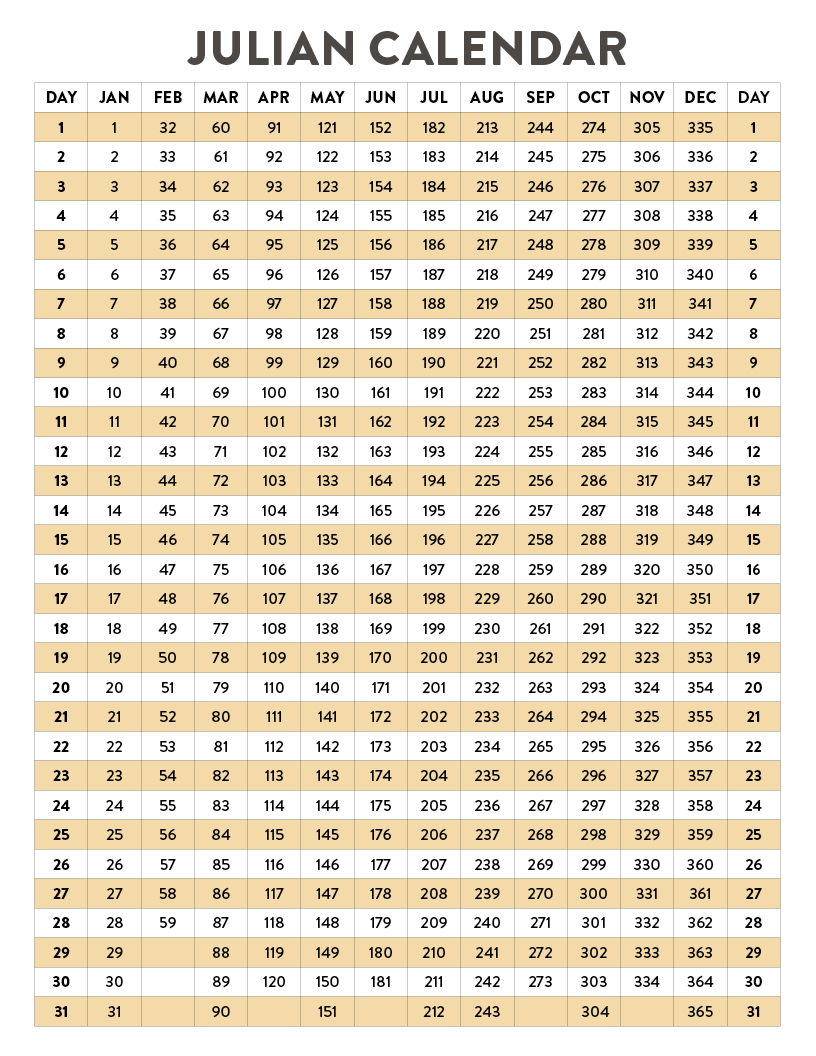
Source : naturalgrocers.com
What “Old Style” Actually Means
Old Style” dates. You’ll see this term a lot when people talk about historical records or the Julian calendar. It simply refers to dates reckoned by the Julian calendar system, the one that was in use before the Gregorian reform. So, any mention of an “Old Style” date in 2026 is a reference to a date calculated according to the older, less accurate leap year rules. It’s the marker for the calendar most of the world used for centuries before we switched gears. Think of it as the original blueprint.
The Accumulating Error
The reason we call it “Old Style” is because of its accumulated error. Remember that 11-minute-per-year overestimation? By the time the Gregorian calendar was introduced in the 16th century, the Julian calendar had drifted by about 10 days. Fast forward to 2026, and that drift has grown to 13 days. An old style date might seem straightforward, but its true position in the solar year is different from what the Gregorian calendar shows. This drift is the core issue that prompted the calendar change in the first place.
Navigating Old Style in the Modern World
So, how does this play out in 2026? If you’re dealing with historical documents, especially from Britain or its colonies before 1752, or from parts of Europe before the 1580s, you’ll likely encounter Old Style dates. You might see something like “February 29th, 1700 (O.S.)”. Now, February 29th, 1700, Gregorian, never happened because 1700 wasn’t a leap year in the Gregorian system. But it was a leap year in the Julian system. So, that date converts to March 12th, 1700 (N.S. – New Style). Understanding Old Style dates is essential for anyone digging into historical records; it’s the key to unlocking accurate timelines.
Frequently Asked Questions
-
What’s the main difference between the Julian and Gregorian calendars?
Look, the Julian calendar is older. It’s what folks used for ages. The big deal is how it handles leap years. It adds one every four years, no exceptions. The Gregorian calendar, the one most of us use today, is way more accurate. It skips leap years in most century years (like 1700, 1800, 1900), only doing it for years divisible by 400 (like 2000). This tiny difference adds up over centuries, making the Julian drift out of sync with the seasons. That’s why we switched.
-
Will the Julian calendar affect holidays in 2026?
For most people, especially in the West, holidays in 2026 will stick to the Gregorian calendar. So, Christmas is still December 25th, New Year’s Day is January 1st, and so on. However, some Orthodox Churches, like the Russian Orthodox Church, still follow the Julian calendar for their religious observances. This means their Christmas falls on January 7th (Gregorian) instead of December 25th. So, for those specific communities, yes, the Julian calendar still has a big impact on when they celebrate.
-
How many days off is the Julian calendar in 2026?
By 2026, the Julian calendar is about 13 days behind the Gregorian calendar. So, if you’re looking at a Julian date, say March 1st, it would actually be March 14th on our standard Gregorian calendar. This difference gets a bit bigger every few centuries, but for now, it’s that 13-day gap. It’s a noticeable lag, for sure.
-
Who still uses the Julian calendar today?
It’s not super common anymore, but you’ll find pockets of people. Primarily, certain Orthodox Christian churches use it for their liturgical calendar. Think of the Russian, Serbian, and Georgian Orthodox churches, among a few others. Some folks in these communities might still refer to Julian dates for religious events. It’s mostly a religious or traditional thing now, not for everyday life for most people worldwide.
-
Is the Julian calendar still relevant in 2026?
For daily life? Not really, unless you’re deeply involved with certain Orthodox traditions. The Gregorian calendar is just too accurate and widely adopted. But is it relevant historically and culturally? Absolutely! It’s a huge part of our understanding of timekeeping and how calendars evolved. Plus, knowing about the Julian date helps understand why some religious holidays fall on different Gregorian dates for different groups. So, yeah, it’s still got a place in the conversation.