Old Style Dates vs. New Style Dates: What’s the Deal in 2026?
Ever look at a historical document and see a date that just seems…off? Like, how could it be January 5th, 1752, when your birthday is the 5th, and that feels like ages ago? Well, buckle up, because we’re diving into the wild world of Old Style (OS) and New Style (NS) dates. It’s not as complicated as it sounds, but it sure can mess with your head if you’re not in the know. Especially when we start talking about Julian Calendar 2026. Yeah, a calendar that hasn’t been the standard for centuries is still relevant. Go figure.

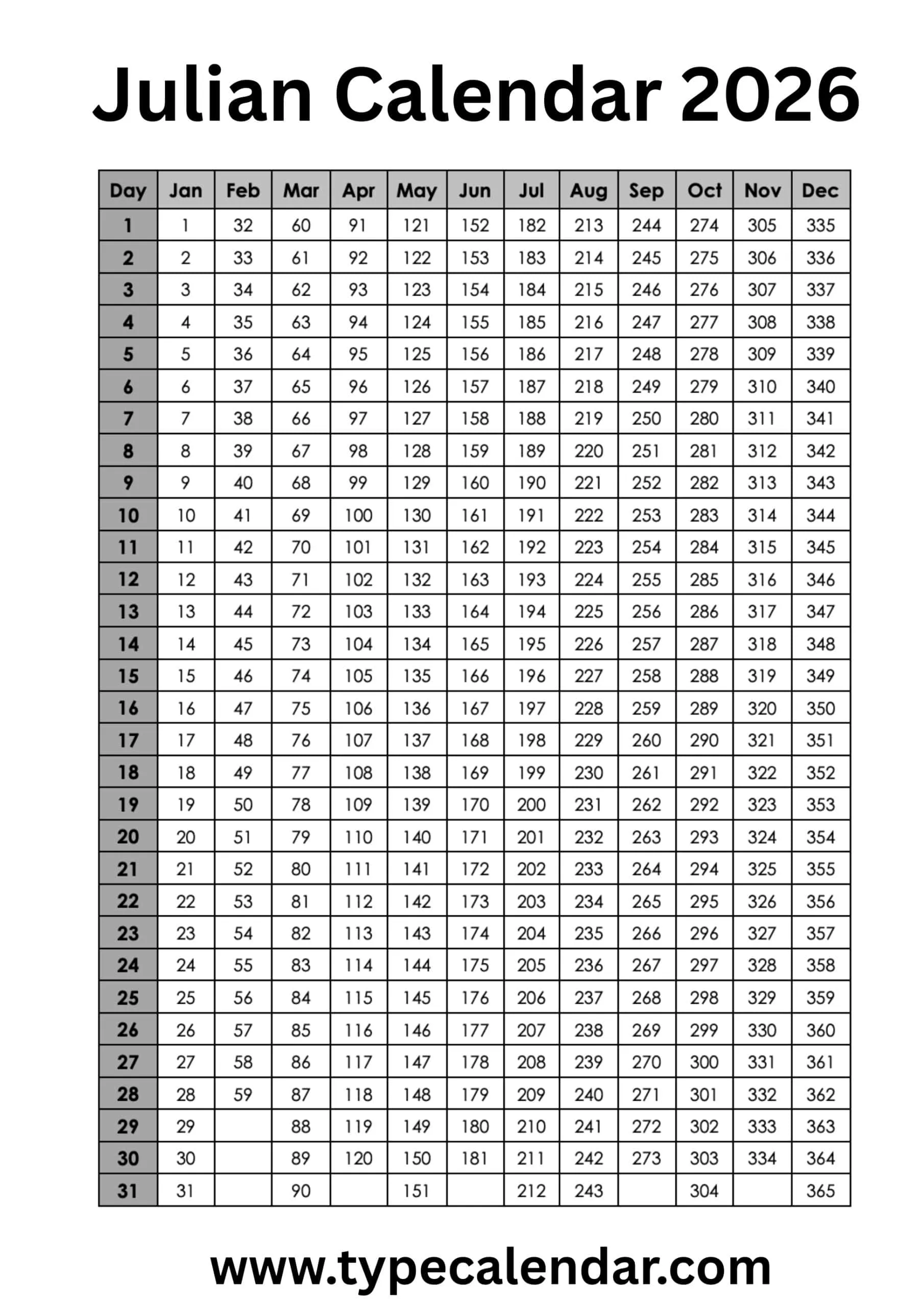
Source : typecalendar.com
For centuries, much of the Western world marched to the beat of the Julian Calendar. It was pretty good for its time, introduced by Julius Caesar way back in 45 BC. But here’s the kicker: it was just a smidge off. A tiny little error, but over hundreds of years, it added up. Like a slow drip wearing away stone. By the 16th century, this ‘smidge’ had become a noticeable gap. Pope Gregory XIII stepped in, said “Enough is enough,” and gave us the Gregorian Calendar in 1582. Much better. More accurate. The one we use today.
But here’s where it gets sticky. Not everyone jumped on board with Pope Gregory’s shiny new calendar right away. Some countries, especially those with a bit of religious or political beef with Rome, stuck with the old Julian system for ages. This created a split. You had two different dates floating around for the same day. One was the Old Style date from the Julian calendar. The other was the New Style date from the Gregorian calendar. And this, my friends, is why you’ll see historical records with dates that make you scratch your head.
Why Should I Care About Old Style Dates in 2026?
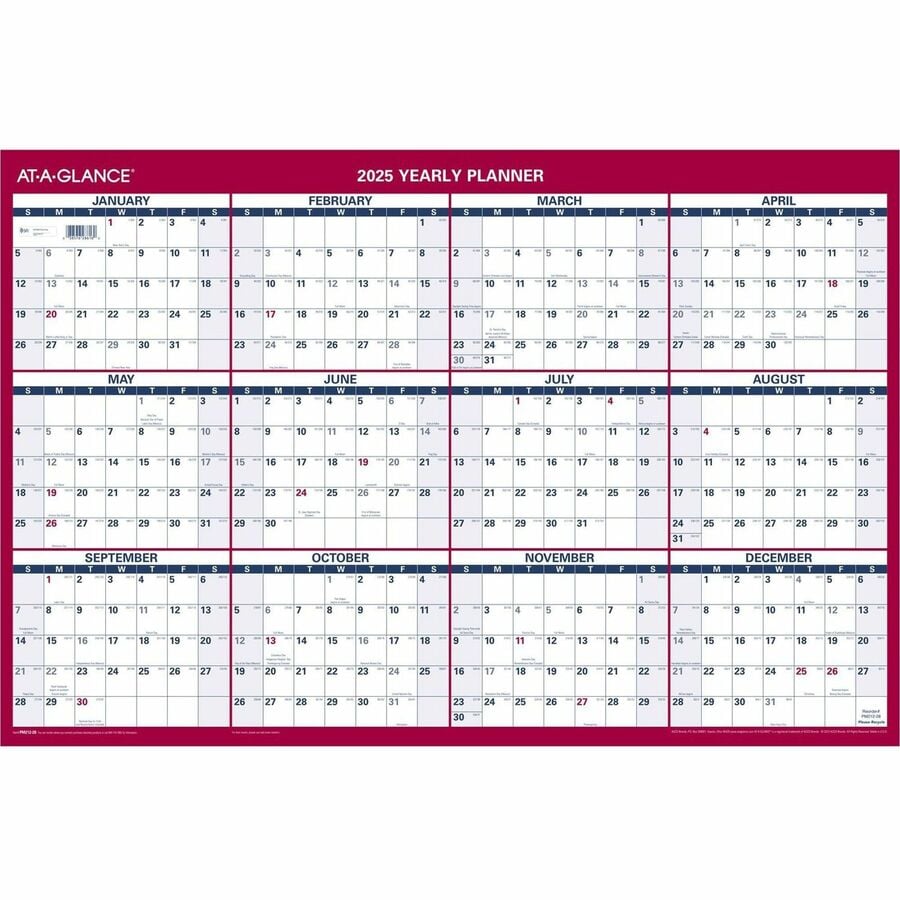
Source : sandhillsofficesupply.com
Okay, so why are we even bothering with this ancient history for 2026? It’s simple. The Julian calendar, despite being replaced, never truly went away in certain contexts. Think of Orthodox churches. Many still use the Julian calendar for their liturgical celebrations. This means their holidays often fall on different days than what you’d expect based on the Gregorian calendar. Christmas, for instance. For some, it’s December 25th. For others, it’s January 7th (which is December 25th on the Julian calendar!).
So, when you see references to events or dates related to these traditions, you might encounter Old Style dating. It’s not just about religious holidays, either. Historical research, genealogy, and even certain academic circles might still reference or require understanding Old Style dates. Especially when dealing with records from places like Russia or parts of Eastern Europe before major calendar reforms took hold there. The year 2026 isn’t some magic cutoff; the Julian calendar’s influence lingers.
Plus, let’s be honest. It’s a fascinating peek into how we’ve measured time. It shows how science, religion, and politics have all tangled up together to shape something as fundamental as our calendar. Understanding Old Style is like finding a secret code in historical documents. It gives you a richer, more accurate picture of the past. And who doesn’t like a good historical mystery?
The Julian vs. Gregorian Skirmish: A Quick Timeline
Let’s break down the main differences between these two calendar systems. It all boils down to the leap year. The Julian Calendar added a leap day every four years, no exceptions. Sounds simple, right? Well, the Earth’s orbit isn’t exactly 365.25 days. It’s a tiny bit shorter. This made the Julian year about 11 minutes too long.
Not a big deal at first. But fast forward 1,600 years, and that 11-minute error per year had accumulated into a whopping 10-day difference by the time Pope Gregory XIII stepped in. He basically said, “We need to catch up!” So, in 1582, 10 days were skipped. October 4th was followed immediately by October 15th. Ouch. That’s how you get the Gregorian Calendar, our modern, much more accurate system. It refines the leap year rule: leap years happen every four years, except for years divisible by 100 but not by 400. So, 1700, 1800, and 1900 weren’t leap years in the Gregorian calendar, but 2000 was. This tiny adjustment keeps things ticking much closer to the actual solar year.

Source : store.ancientfaith.com
But the switch wasn’t instant. Great Britain and its colonies (including what would become the United States) didn’t adopt the Gregorian calendar until 1752. By then, the difference had grown to 11 days. So, September 2nd, 1752, was followed by September 14th. Imagine the chaos! And some places held out even longer. Russia, for example, didn’t officially switch to the Gregorian calendar until after the 1917 revolution. All this history is why understanding Old Style dates is still a thing, even as we look towards 2026.
Deciphering Old Style Dates: What Year is It, Really?
So, you’re staring at a document from, say, 1700. It says “February 10th, 1700.” Is that the 10th of February in our modern calendar? Maybe. Or maybe not. In Old Style, 1700 was a leap year. But in New Style (Gregorian), it wasn’t. This leads to confusion, especially around the turn of the year.
Here’s another tricky bit: the start of the year. For a long time, many places in Europe considered March 25th to be the start of the new year (Lady Day). So, February 10th, 1700, Old Style, would actually fall before March 25th, 1700. But in the New Style calendar, January 1st marked the new year. So, February 10th, 1700, Old Style, would be equivalent to February 21st, 1700, New Style. (The Julian calendar was 10 days behind the Gregorian in the 1700s). See how it adds up? It’s a veritable puzzle!
This difference in the start of the year is a big reason why you sometimes see dates written with two year numbers, like “1700/01” or “1700-01.” The first number is the Old Style year, and the second is the New Style year, indicating the point in the calendar year. It’s a way historians and archivists try to avoid ambiguity. When you’re digging into records that might relate to the Julian Calendar or Old Style dates, keep this dual-dating system in mind. It’s crucial for accurate interpretation.
Old Style Dates in 2026: What Does It Mean For You?
When we talk about Old Style dates and the Julian Calendar in relation to 2026, it’s primarily about historical context and specific traditions. The Gregorian calendar is the undisputed standard for daily life, business, and government. No one’s expecting you to start celebrating Christmas on January 7th unless you’re part of a specific religious community that observes it that way.

Source : calendarlover.com
However, if you’re a history buff, a genealogist tracing your roots, or studying historical events that occurred before the widespread adoption of the Gregorian calendar, then understanding OS/NS dating is vital. You might be looking at birth records, census data, or even old newspaper clippings. Without knowing about the calendar differences, you could easily misinterpret when something happened or how old someone was. For example, discovering an ancestor born in “1750 OS” requires you to do the math to figure out their actual age based on the NS calendar. You can find fascinating details about this historical transition in resources like Wikipedia’s entry on Old Style and New Style dates.
The significance for 2026 is simply that time marches on, and historical records remain. The Julian calendar’s legacy persists in cultural practices and historical documentation. It’s a reminder that our present is built on layers of past conventions. Understanding these layers helps us appreciate the evolution of timekeeping itself. It’s not about using the Julian calendar; it’s about understanding its historical footprint.
FAQ: Your Burning Questions About Old Style Dates and 2026 Answered
What old calendar years are used in 2026?
That’s a bit of a trick question! In everyday life, we only use the Gregorian Calendar in 2026. So, technically, no “old calendar years” are in use for daily life. However, the Julian Calendar, which represents Old Style dates, is still used by some Orthodox churches for their liturgical calendar. So, while your calendar app will show Gregorian dates, certain religious observances in 2026 might still be calculated using the Julian system. It’s a fascinating historical calendar overlap that persists.
What vintage calendars line up with 2026?
Great question! When we talk about “vintage calendars lining up,” it’s really about finding periods where the date system was the same as ours today, or figuring out the difference. The Gregorian Calendar, the one we use now, was established in 1582. So, any Gregorian calendar from 1582 onwards will use the same system as 2026. However, before that, or in places that hadn’t adopted it yet, you’d be looking at Old Style dates based on the Julian Calendar. Finding exact “vintage” calendar pages that align perfectly with 2026 is tricky because the day of the week shifts each year. But the system of the Gregorian calendar is what matters, and that’s been around for centuries. For a deeper dive into the calendar itself, check out Britaica’s explanation of the Julian calendar.
How many days were different between the Julian and Gregorian calendars in 1752?
Ah, 1752! That was a big year for calendar reform in places like Great Britain and its colonies. By that point, the accumulated error in the Julian Calendar had grown to a significant 11 days. So, when they officially adopted the Gregorian Calendar, they had to skip 11 days. September 2nd, 1752, was immediately followed by September 14th, 1752. Imagine losing 11 days out of nowhere! It caused quite a stir.
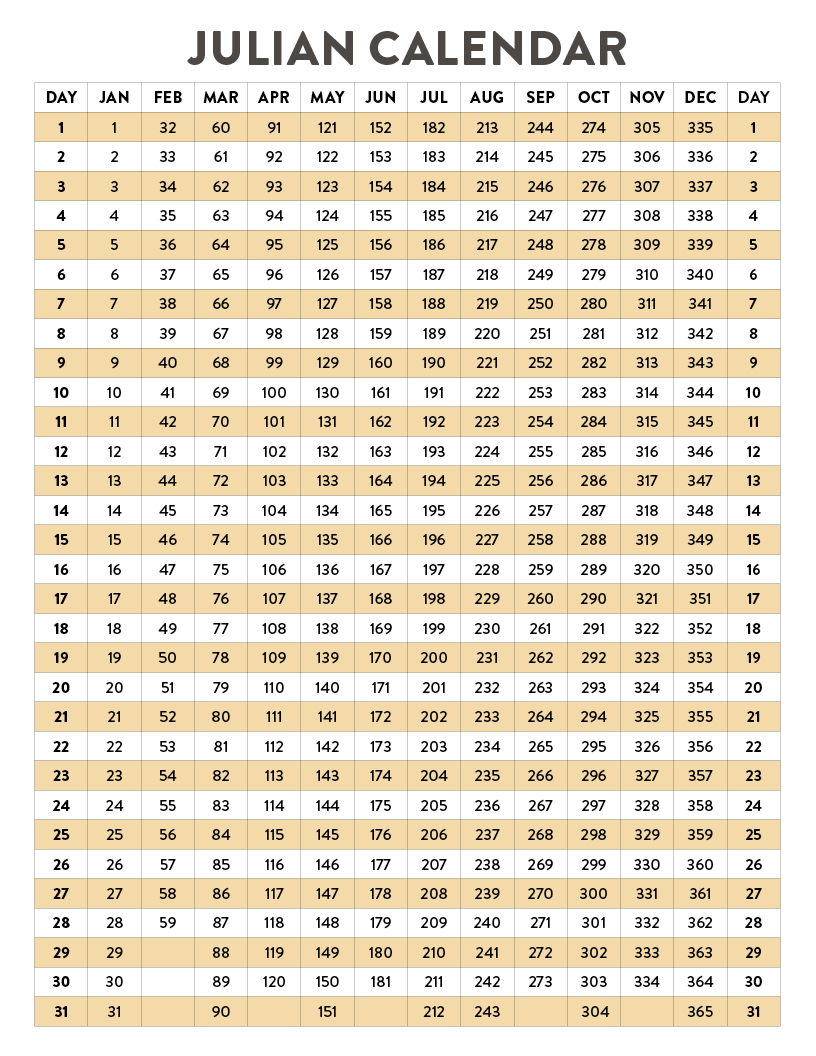
Source : naturalgrocers.com
Can I still find historical records using Old Style dates?
Absolutely! If you’re into genealogy or historical research, you’ll definitely stumble upon Old Style dates. Think about records from Russia before 1918, or England and its colonies before 1752. These documents often use the Julian calendar system. Sometimes they’ll even write the date with two year numbers (like 1700/01) to show both the Old Style and New Style equivalents. It’s a real treasure trove for historians, but you need to know how to read it! Understanding this is key to accurate historical timelines.
Are Old Style dates still relevant for any holidays in 2026?
Yes, but only in specific contexts. The main area where Old Style dates remain relevant for holidays is within some Eastern Orthodox Churches. They continue to use the Julian Calendar for calculating feast days. This is why Christmas, for example, is celebrated on January 7th by some Orthodox Christians – that date corresponds to December 25th on the Julian calendar. So, while secular society operates on the Gregorian calendar for 2026, these religious traditions keep the Julian calendar’s influence alive. It’s a beautiful blend of tradition and timekeeping.
What is the difference between Old Style and New Style dates?
Simply put, Old Style (OS) refers to dates calculated using the Julian Calendar, and New Style (NS) refers to dates using the more accurate Gregorian Calendar. The main difference comes from the leap year calculation. The Julian calendar was about 11 minutes per year too long, causing a drift over centuries. The Gregorian calendar corrected this. So, OS dates are behind NS dates. The exact number of days they are apart changed over time (10 days in the 16th century, 11 days by the 18th century, and so on). It’s crucial for historians and genealogists to know which system they’re looking at. You can read more about the nitty-gritty at Oreate AI’s blog on calendar significance.
Frequently Asked Questions
-
What old calendar years are used in 2026?
That’s a bit of a trick question! In everyday life, we only use the Gregorian Calendar in 2026. So, technically, no “old calendar years” are in use for daily life. However, the Julian Calendar, which represents Old Style dates, is still used by some Orthodox churches for their liturgical calendar. So, while your calendar app will show Gregorian dates, certain religious observances in 2026 might still be calculated using the Julian system. It’s a fascinating historical calendar overlap that persists.
-
What vintage calendars line up with 2026?
Great question! When we talk about “vintage calendars lining up,” it’s really about finding periods where the date system was the same as ours today, or figuring out the difference. The Gregorian Calendar, the one we use now, was established in 1582. So, any Gregorian calendar from 1582 onwards will use the same system as 2026. However, before that, or in places that hadn’t adopted it yet, you’d be looking at Old Style dates based on the Julian Calendar. Finding exact “vintage” calendar pages that align perfectly with 2026 is tricky because the day of the week shifts each year. But the system of the Gregorian calendar is what matters, and that’s been around for centuries. For a deeper dive into the calendar itself, check out Britaica’s explanation of the Julian calendar.
-
How many days were different between the Julian and Gregorian calendars in 1752?
Ah, 1752! That was a big year for calendar reform in places like Great Britain and its colonies. By that point, the accumulated error in the Julian Calendar had grown to a significant 11 days. So, when they officially adopted the Gregorian Calendar, they had to skip 11 days. September 2nd, 1752, was immediately followed by September 14th, 1752. Imagine losing 11 days out of nowhere! It caused quite a stir.
-
Can I still find historical records using Old Style dates?
Absolutely! If you’re into genealogy or historical research, you’ll definitely stumble upon Old Style dates. Think about records from Russia before 1918, or England and its colonies before 1752. These documents often use the Julian calendar system. Sometimes they’ll even write the date with two year numbers (like 1700/01) to show both the Old Style and New Style equivalents. It’s a real treasure trove for historians, but you need to know how to read it! Understanding this is key to accurate historical timelines.
-
Are Old Style dates still relevant for any holidays in 2026?
Yes, but only in specific contexts. The main area where Old Style dates remain relevant for holidays is within some Eastern Orthodox Churches. They continue to use the Julian Calendar for calculating feast days. This is why Christmas, for example, is celebrated on January 7th by some Orthodox Christians – that date corresponds to December 25th on the Julian calendar. So, while secular society operates on the Gregorian calendar for 2026, these religious traditions keep the Julian calendar’s influence alive. It’s a beautiful blend of tradition and timekeeping.
-
What is the difference between Old Style and New Style dates?
Simply put, Old Style (OS) refers to dates calculated using the Julian Calendar, and New Style (NS) refers to dates using the more accurate Gregorian Calendar. The main difference comes from the leap year calculation. The Julian calendar was about 11 minutes per year too long, causing a drift over centuries. The Gregorian calendar corrected this. So, OS dates are behind NS dates. The exact number of days they are apart changed over time (10 days in the 16th century, 11 days by the 18th century, and so on). It’s crucial for historians and genealogists to know which system they’re looking at. You can read more about the nitty-gritty at Oreate AI’s blog on calendar significance.

Nichols As the lead creator behind platforms like Month Mint Calendar & Fest, Nichols focuses on the intersection of clean design and daily productivity. Finding the perfect balance between aesthetics and functionality, Nichols ensures that every grid and tracker is meticulously crafted for optimal print quality.